A framework · From The Human Cost of Competence

How to stop overfunctioning

Overfunctioning is doing for others what they could do for themselves, consistently, and at your own expense. It looks like competence from the outside. Underneath, it usually runs on a quiet fear: if I stop, it all drops. The exhaustion lands on the one carrying. The growth it prevents lands on everyone else.

You can care deeply without carrying it all.

How it starts

Nobody decides to overfunction.

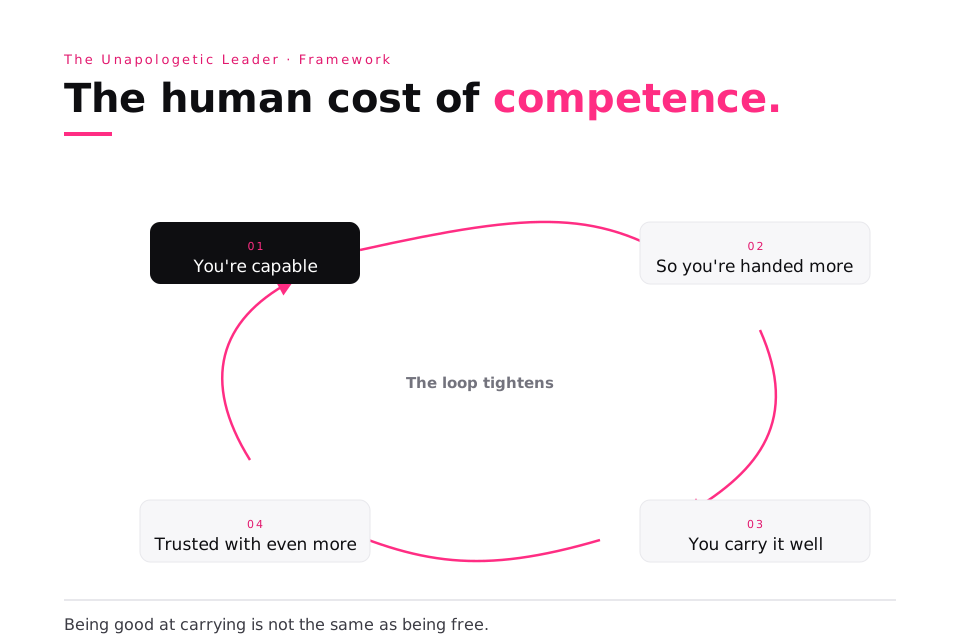
You get good at something, and being good has gravity. The capable one gets handed more. She carries it well, so she's trusted with more. Somewhere in that loop, other people's responsibilities quietly change addresses, and now they live with you.

At work it looks like being the person every escalation finds. At home it looks like being the default parent, the default rememberer, the default fixer of moods. In relationships it looks like managing someone else's feelings so carefully that they never have to learn to hold them.

I know the loop from the inside. I wrote "I think I'm doing everything anyone can" in a journal once. On a good day. That sentence is what this whole body of work grew out of.

The competence loop: capability attracts responsibility, which the capable person carries well, which attracts more responsibility until they become the load-bearing wall.
The signs

Some of these will feel like personality. They’re pattern.

If more than three of those landed, keep reading. Not because something is wrong with you. Because something was handed to you, and nobody asked if you wanted it.

What overfunctioning is not

The wrong door is caring less.

It’s easy to hear all this and conclude the answer is caring less. That’s the wrong door.

Support stays beside someone and trusts their capacity. Carrying steps in front of them and quietly doubts it. Support renews the giver. Carrying drains her. The love was never the problem. The full framework for that line lives here: The Difference Between Love and Carrying.

How to put it down

Not all at once. One brick at a time.

This is the practice, and it works as a journal exercise or a Sunday-night ritual.

01Take the inventory.One page, three columns: mine · ours · never mine. List everything you’re currently holding: tasks, moods, outcomes, other people’s growth. Most women who do this find the third column is the longest, and that finding it is the first relief.
02Return one thing.Pick a single item from the third column and put it down where its owner can reach it. Say it out loud if it helps: this was never mine. Not dropped in anger. Returned.
03Hold the wobble.Whatever you returned will be done worse than you’d do it, for a while. That wobble is not failure. It’s the sound of someone else’s capacity coming back online. Cultivating means tending conditions and trusting capacity; controlling means managing outcomes and staying indispensable. Only one of those works when you’re not in the room.
04Watch for the reflex.The urge to take it back will arrive dressed as love, or efficiency, or "it’s just easier." It’s the old loop asking for its job back. You can notice it without obeying it.
05Give yourself the permission you were waiting for.Most of us weren’t waiting for a strategy. Permission to rest. Permission to be misunderstood while the system rebalances. Permission to stop proving. It was always yours to give.
If you want to go further
The letter that started this.On carrying what was never yours, and the human cost of being the competent one.
The field guide.Build What’s Next. Stay Human. Fifty-four pages, the place most people start.
The Dispatch.Letters on leadership, identity, and becoming. Free, and only when there’s something real to say.
Mentorship.For the season when reading about it isn’t enough.
Asked & answered

The questions people bring here.

What is overfunctioning?Overfunctioning is a pattern of taking on responsibilities, emotions, and outcomes that belong to other people, consistently and at your own expense. It’s common in highly capable people because capability attracts responsibility, and it’s often mistaken for helpfulness or leadership.
What causes overfunctioning?Usually some mix of early training (being the responsible one was how you earned safety or love), environments that reward it, and the honest fact that you’re good at it. The pattern is reinforced every time carrying something works and putting it down feels dangerous.
What’s the difference between overfunctioning and being helpful?Help is offered and finished. Overfunctioning is assumed and permanent. Help builds the other person’s capacity; overfunctioning replaces it. A useful test: if you stopped, would they learn, or would they simply find another you?
What is overfunctioning in a relationship?One partner manages the household, the emotions, the calendar, and the repair of every conflict while the other’s capacity goes unused. Over time the overfunctioner grows exhausted and resentful, the underfunctioner grows smaller, and both mistake the arrangement for their personalities.
How do I stop overfunctioning without everything falling apart?Gradually, and on purpose: inventory what you’re carrying, return one thing at a time to its owner, and tolerate the short season where it’s done worse than you’d do it. Some things will wobble. Very few actually fall. What mostly falls is the belief that you were the only thing holding it up.
You became who they needed. The next part is becoming who you are.

Start here: the letter →

The Unapologetic Dispatch

Letters on leadership, identity, and becoming.

Reflections from the work of building a life and a body of work without apology. No hype. No noise, something worth sitting with.

Free. Arrives when there’s something real to say. Or read past letters →